


Top Questions Multifamily Investors Can Answer with Radix Research
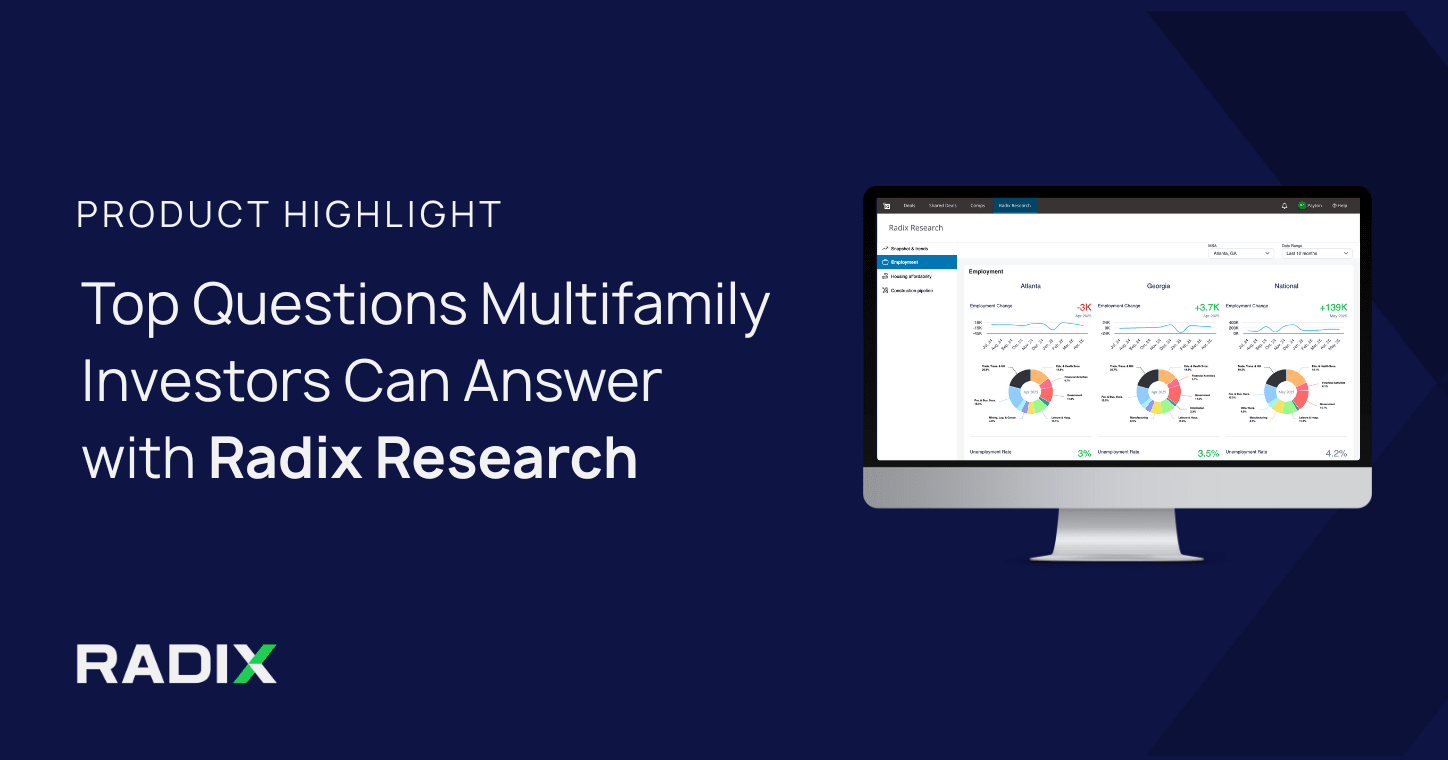

Top Questions Multifamily Investors Can Answer with Radix Research
Investing in multifamily properties requires more than just looking at a single building’s financials. It demands timely, accurate market-level intelligence. Radix Research, accessible through both Radix Underwriting and Radix Analytics, provides the reporting and data essential for sizing opportunities, anticipating risk, and refining your investment strategy.
Below, we’ve outlined critical questions that investors can answer using Radix Research. See the questions, broken down by relevant report, and the value of having these questions answered during the transaction process.
Market Insights: Snapshots & Trends Report
Before committing capital, you need to know how a market and its assets are performing. The Snapshot & Trends report delivers breakdowns of key rent and leasing metrics at the sub-market, market, state, and national levels.
How does a specific market compare to the state as a whole?
When net effective rents, concessions, or occupancy rates outpace state averages, it can signal strong local demand and potential for above-average rent growth. If a market lags, it may indicate softening fundamentals or a need for more cautious underwriting.
Which submarkets are outperforming within a given market?
The Snapshot & Trends report allows you to identify the strongest submarkets based on the data points captured in the report. Spotting outperforming submarkets early helps investors focus acquisitions, target development opportunities, and avoid areas showing early signs of cooling.
Upcoming Deliveries: Construction Pipeline Insights
Future supply has a direct impact on rent growth, occupancy, and asset performance. Understanding what’s being built (and when it will deliver) helps investors anticipate market shifts, assess competition, and make more informed acquisition or disposition decisions.
How many new developments are planned near my target property?
The volume of new supply can signal how competitive a market will become over the next 12–24 months. A surge in planned deliveries may compress rent growth and increase lease-up risk, while limited new construction could create scarcity-driven pricing power.
What types of projects are being completed nearby?
Construction projects aren’t all the same. Identifying whether surrounding projects are ground-up developments or renovations is key to assessing direct competition and understanding their potential impact on your property’s tenant demand and pricing.
What stage of the construction lifecycle are these developments in?
The timing of new supply is just as important as the volume. Projects still in early planning pose less immediate risk, while those in lease-up may soon impact performance. Understanding the development pipeline’s composition allows investors to time investments more strategically.
Economic Health: Employment & Affordability Reports
The Housing Affordability and Employment reports cover factors related to local economies. Renter demand and rent growth are closely tied to local economic health and affordability.
On average, how much of a renter’s income goes toward rent?
Knowing the share of income renters devote to housing reveals a market’s affordability and how much room there may be for rent growth. High rent-to-income ratios can signal potential resistance to future increases, while lower ratios may point to untapped pricing power and stronger long-term demand.
Which job sectors drive employment in the market?
Understanding which industries fuel a region’s employment base reveals the strength and resilience of the local economy. A market anchored by diverse job sectors—such as healthcare, technology, or logistics—can better withstand economic shifts, supporting steadier renter demand and rent growth. Conversely, reliance on a single sector can signal higher risk during industry downturns.
How many jobs are being added or lost each month?
Monthly job gains and losses provide a real-time read on a market’s economic momentum. Consistent job growth typically signals rising housing demand and stronger rent fundamentals, while sustained job losses can foreshadow softer occupancy and slower rent growth. For investors, tracking these shifts is key to anticipating market cycles and making informed acquisition or disposition decisions.
What is the unemployment rate and how is it trending?
The unemployment rate is a leading indicator of housing demand and market stability. A declining rate often signals a growing job base and stronger renter demand, supporting potential rent growth. Conversely, a rising rate can warn of economic softening, which may lead to slower leasing activity or increased concessions.
The Big Picture: Make Decisions, Fully-Informed
The most successful multifamily investors go beyond property-level analysis, aiming to understand broader forces shaping market performance, supply dynamics, and renter demand. Radix Research brings these layers of intelligence to investors in both Radix Underwriting and Radix Analytics.
Whether you’re evaluating a potential acquisition, monitoring your existing portfolio, or deciding when to re-enter a market, the insights Radix Research provides help you act with clarity and confidence.
The questions and answers above represent only a portion of the intelligence that investors receive with Radix Research. With access to granular data from the submarket to the national level, you’re equipped to make better decisions at every point in the asset lifecycle. Request a demo of Radix Underwriting or Radix Analytics today.
About Radix
Radix advances intelligent decision-making across the multifamily ecosystem. We provide transparent, accessible data to every stakeholder—investors, managers, brokers, lenders, and renters—enabling smarter choices that shape how we invest, live, and grow. With Radix Analytics and Radix Underwriting, professionals can source, acquire, and manage assets with confidence. Renters benefit from RealRents, which delivers unprecedented pricing transparency and helps them find homes that truly fit their needs. Whatever your role in multifamily, Radix is the trusted source of value determination.
Stay Informed, Stay Ahead.
It’s okay, we hate spam too.We’ll only send you things worth reading, and your email won’t end up on some list you never signed up for.